Saturday, 22 March 2014

Leftovers

Gardening season Alberta is short; the first killer frost of one winter is never far enough behind the last killer frost of the previous winter.  That said, gardening season does sometimes go on longer than some of us would like.  Past the time when squash and tomato leaves have turned black and even the Swiss chard has had a few good scares, I am still at work, cleaning up my carefully cultivated out-of-control mess.  Pulling up roots, pushing stalks through the shredder, and watching the compost bin fill with next year's fodder can be satisfying, if not exactly fun, on a grey and windy November weekend.  More importantly, it is a kindness to my future self, the one who will have ready garden beds the following April, when the weather is finally conducive to sowing.

The fall of 2013 didn't unfold as well as it could have in this respect.  We were distracted by interior issues, namely the deconstruction and reconstruction of our kitchen.  A family health crisis took me out of town on the all-important Thanksgiving weekend in October and held my attention for the ensuing weeks.  Winter came early.  By the time my interest in garden work returned, the ground was frozen.  Whatever was in it - parsnips, sun chokes, vine supports, tomato roots, leeks - was going to stay until spring thaw.  It was a bit of a relief; I didn't feel like digging in the dirt in November.  At some point I did make the modest effort to poke garlic cloves into the soil, though I see now that I failed to secure a good layer of mulch to cover them.

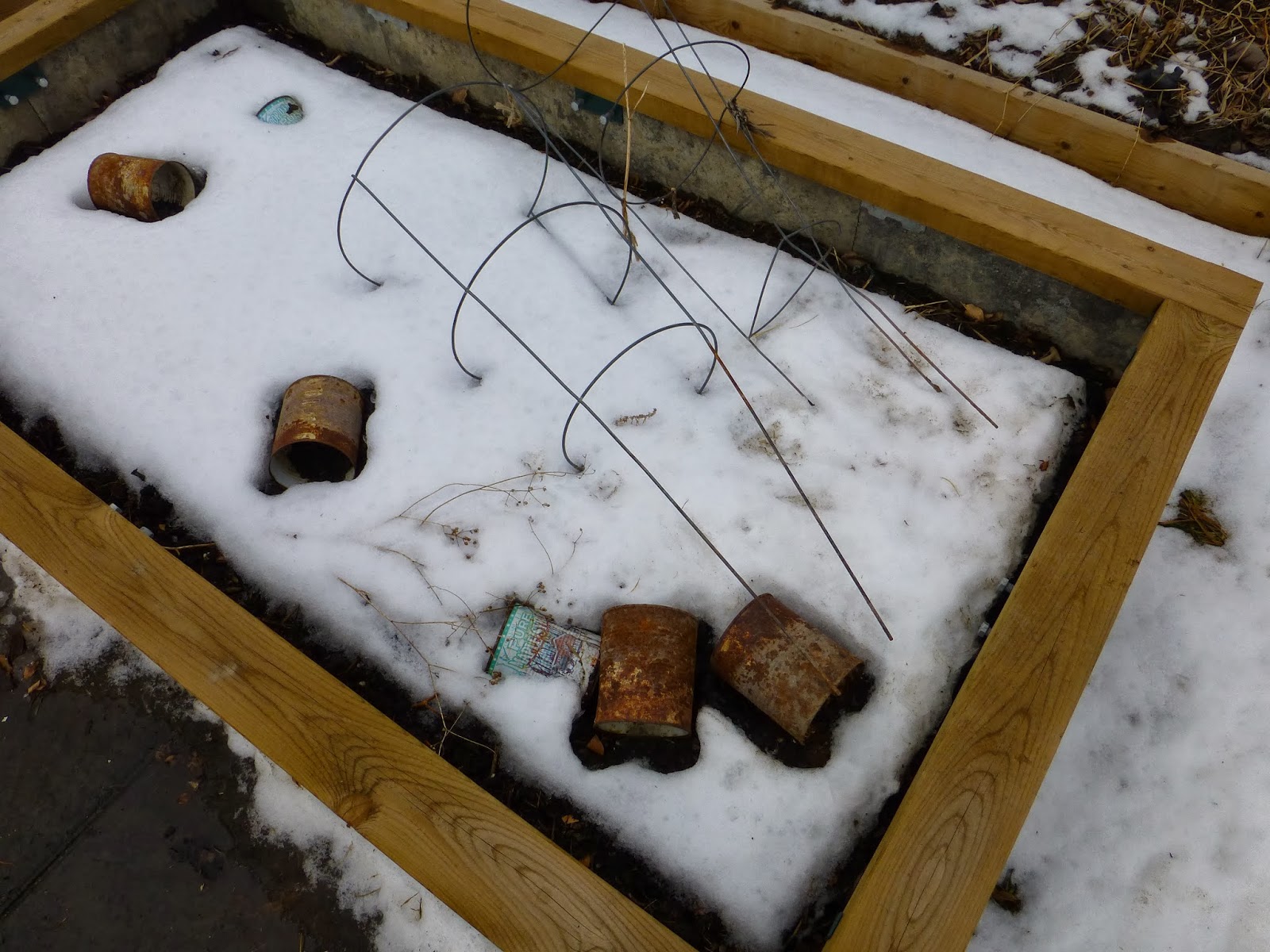
Through the winter I've been well aware of the general mayhem of the the garden beds.  Even a thick layer of snow couldn't hide much of it.  Tomato cages, cutworm collars, pea fences, random stalks, and plants that kept trying until the bitter end are all eyesores.  Now that the snow has retreated, if temporarily, much of the landscape looks sadly neglected.  I hope it doesn't depress the neighbours........


.........This post was begun and abandoned two or three weeks ago.  Since then, a dramatic thaw has allowed me to unearth a few parsnips (now baking in the oven) and Barry has shredded a huge pile of woody matter.  In the course of a perfunctory clean-up, I found living leaves - Swiss chard, sage, thyme, onion - and suggested they not get too excited about spring just yet.  Sure enough, we now have a blanket of pure white snow and -17C on the weather station.  The pendulum will swing yet again.  Our seed order arrived two days ago; the activation process begins this weekend.  So much to look forward to.

Sunday, 15 September 2013

My prize cabbage

This was our first attempt to grow cabbage.  We have grown broccoli, cauliflower, brussel sprouts, pak choi, and turnips, with less than laudable results.  I like to blame the cabbage moths that allow their ravenous offspring to destroy the leaves.  Radishes have always seemed to escape the pestilence, which is a faint blessing because they usually bolt and make their roots unpalatable before the eggs even hatch.

This year's quest for failure was Red Express cabbage.  Sown March 30, planted out May 6, narrowly escaping an avian abduction May 18, one of the plants became the jewel of the garden.  I soon began referring to it as "my prize cabbage" and wondered if there was indeed a contest it could enter, a beauty pageant for vegetables.


The Hope Seeds catalogue declared that the cabbage should be ready for harvest 65 days after transplant.  The above photo was taken several days past that point.  I still thought it might want to grow a little more.  Plus, I was deriving so much pleasure from the sight of it, it was hard to imagine that eating it could be any better.  Ironically, the only way we could ensure those fabulous unblemished leaves was to keep the cabbages under row cover fabric.....opaque white row cover fabric.  But then I did not become habituated to its beauty, and I gasped with delight each time the cover was removed for watering or weeding.  

Weeks passed.  Cabbage moths had gained entry.  The row cover fabric that had sustained minor hail damage in June was now strained by the upward mobility of several stout broccoli stems.  Who knew they would grow so tall?  Holes were enlarged enough for a determined butterfly to pass through and the fabric was just barely wide enough to reach down to both sides of the bed.  Fat green cabbage worms were having a feast on the smaller cabbages.  There were a few holes in the outer leaves of the prize cabbage, but the head seemed too solid to penetrate.  Nevertheless, even if it was safe from chewing, it might not be wise to leave the cabbage in the garden much longer.  

The summer has been hot and dry. Not exactly cabbage weather.  I have read of cabbage heads splitting and bolting, which sounds very dramatic and I would like to witness it, but not occurring in this particular individual.  Even if it didn't bolt, what might be going on chemically?  I much prefer my cabbage cool, and did not want to be confronted with the burning sensation that has put me off cabbage before.  My fear that it might go to waste helped me to do what had to be done.  On August 24, with the head in my left hand and the secateurs in my right, I slaughtered my prize cabbage.  The experience suggested to me that maybe I should not raise animals for meat.

Fortunately, once all the outer leaves were removed and the plain bald purple head was left bare, it was less familiar to me.  There was no hesitation when it came to cleaving the head in half with a kitchen knife.  
The inside was as perfect as the exterior.  Tight folds of white and purple, crammed together by forces I could not fathom.  How do the leaves get packed so tightly by only the force of other leaves?
The entire head was shredded for coleslaw, on quarter at a time.  Delicious. None of the heat I was worried about; just sweet and tender, for days and days.  This cabbage gave me a lot of joy this summer.  It will be remembered fondly.  


Friday, 6 September 2013

Grape expectations

grape grotto september six

Maybe I should learn to make wine.  Maybe I could!

Monday, 5 August 2013

Growers' guide to good beets

Beets should look like this.....


or this.....


but not like this.  Don't eat these.


I have searched online for beet diseases but yet found nothing to explain this affliction.  They are all from the southeast quarter of the beet bed, the same area where all the sunchokes were covered in fungus when unearthed in the spring, and, interestingly enough, close to one of our many ant hills.  I can't help wondering about that.  Another group of ants appears to have done in this cabbage in an otherwise healthy population.


This colony held its mating event yesterday.   Ants flying through the air are even more off-putting than ants crawling on the ground.  It was of some comfort that the sex-crazed drones were contained within the row cover.  I wonder if mating can happen when the queen's flight is limited to less than two feet.  Later in the afternoon, all was quiet, which is nice in a way but also probably means the queen is back in her chamber manufacturing a fresh batch of workers.

Wednesday, 31 July 2013

Near miss

Pulled back the brassica row cover this evening and discovered....

A BROCCOLI!


A broccoli getting past its prime.  This is for supper tomorrow.

Monday, 29 July 2013

Cucumber down

Two Topsy Turvy planters were put to use this year - one for Bushy cucumbers and one for Tante Alice cucumbers.  As before, I  would gently tug downward on the small transplants, thwarting their attempts to grow skyward because I was trying to get them out of the shade of their planters and into the sunlight.  While they did relax somewhat as they grew heavier, they still managed to extend horizontally more than downward, and this may have been the downfall of one of them.


In the photo above, the plant on the right looks a bit limp.  This is why.  It was hanging by a thread.  The wind blows here, by times.  A linear vine reaching toward the ground might sway in the wind, but a vine maintaining a constant elevation is subject to twisting on its stem.  Too much stress, especially on top of the already bizarre orientation in which I tried to make it grow.  Minutes after this picture was taken, Tante Alice was on the ground.  This is not surprising.  We have a third planter hanging from the clothesline support, left there from last year, with the stub of a broken tomato stem poking out of it.


Topsy Turvy planters are watered from the top and a good soaking should result in some seepage out the bottom.  This particular planter hangs directly over the entrance to an ant metropolis.  Seeing an ant crawling down the side of the planter last week, I surmised she may be an engineer looking to rectify the problem of water intrusion.  Keeping an open mind, since I did not witness the cucumber stem breaking in response to wind-induced torsion, I will allow that ant mandible activity could conceivably have been the cause of breakage.  If so, did the team foresee that the entire mass would end up on their entrance plaza?  I have left it in place to see how they deal with it.


The sole greenhouse cucumber, meanwhile, enjoys the freedom to grow directly away from the ground, as long as it receives some assistance in not keeling over.  I placed a second tier tomato cage on top of the first one after seeing the cucumber almost strangle itself trying to get a grip.


Sunday, 21 July 2013

Birthday perennials

Mom came through again with the $1 per year survival award and once again I pedalled out to Greenhaven Garden Centre to make the most of it.  This year's picks are, clockwise from the left:


Carpet Bugle (Ajuga reptans 'Burgundy Glow') - forms a spreading carpet of leaves dappled in green, cream and smoky pink.  Taller spikes of blue flowers appear in spring.  ~jeeperscreepers.info

Peachleaf Bellflower (Campanula persicifolia blue form) - a low mound of leaves, bearing tall stems of large, bright-blue bells during summer.  ~perennials.com

Kinnikinnik (Arctostahpylos uva-ursi) - low growing, native, evergreen perennial with a spreading habit.  Glossy dark green foliage is highlighted by small pinkish flowers in late spring.  ~Northern Classics

Purple Labrador Violet (Viola labradorica) - a charming violet for shady places.  Forms a low tuft of purple-tinged leaves, with small mauve-purple violets in spring and fall.  ~jeeperscreepers.info

Evening Primrose (Oenothera missouriensis) - a profuse blooming plant.  The red-spotted flower buds open on summer afternoons to yellow cup-shaped flowers.  ~Northern Classics

Purple Rockcress (Aubrieta deltoidea 'Purple Gem') - a compact plant with grey-green spoon shaped leaves.  Deep purple blooms appear in spring and again in late summer.  ~Northern Classics

Red Wonder Pussy-Toes (Antennaria dioica 'Rotes Wunder') - forms a flat carpet of tiny silver-grey leaves, with taller stems of fuzzy cherry-red flowers in late spring,  ~rockstarplants.com

Alpine Wall Cress (Arabis ferdinandi-coburgi 'Old Gold') - forms a very low carpet of rounded waxy-looking green-and-gold streaked leaves.  Small white flowers in spring are a bonus.  ~rockstarplants.com

Left to right from Carpet Bugle:

Wineleaf Cinquefoil (Potentilla tridentata ' Nuuk') - Selected in Greenland, this is a tough little evergreen creeper.  Small white buttercup-shaped flowers appear in late spring and early summer.  Foliage turns wine-red in the colder months.  ~jeeperscreepers.com

Woolly Speedwell (Veronica pectinata) - a low dense carpet of grey-green foliage studded with deep blue, or occasionally lavendar, saucer shaped flowers.  ~jeeperscreepers.com

All ten have found new homes in the front yard.  The most notable development has been this stunning blossom on the evening primrose.


Adding these new specimens to the garden, I could not deny that the colour tendency leans heavily toward the pink-purple-blue range.  This week I wandered the aisles of a garden centre, on the lookout for more yellow-orange hues and discovered they are in short supply for this climate zone.  Blanketflower, yellow coneflower, stonecrop, and now evening primrose (though that is the coldest yellow I have ever seen) make their contribution, but they are greatly outnumbered.  Warm colours should be the priority next time.

As for the 2012 group, results have varied.

creeping lamium, aka dead nettle, is spreading to fill its nook and generated a few pink blossoms in the spring


single painted daisy - the victim of a weeding accident (I thought the thing next to it was the single-painted daisy),
I have been coddling this one with daily watering.  It will be cool if it comes back bigger and better next year.


alpine strawberry - looks great; too bad about the berries (it's hard to tell when a white strawberry is ripe,
and I found too many that were inhabited by creatures)


rock soapwort - quite showy at its peak in spring; not so enthusiastic about summer


variegated periwinkle - had a rough summer 2012 and finally found a shady place around the cotoneaster hedge


fern-leaf bleedingheart - I'm sure this is where I left it last fall


creeping jenny - doing a great cover-up job around hops-on-a-bike;
 too bad it has to live with wilted daffodil leaves


stella d'oro daylily - two blooms so far this summer, but a little lost in its surroundings


moss phlox - holding its own in the rock garden, with pink blossoms this spring