Showing posts with label weeds. Show all posts

Friday, 31 May 2013

Convenience food

When we lived in Vancouver, the weather forecast often promised sunshine that would fail to appear.  They had to give us some hope.  In Lethbridge, the promise is rain.  I decide that I don't have to water the garden because rain is imminent, then arrive home from work in the afternoon to find lettuces prostrate under the sun.  Yesterday we finally got the precipitation we were promised, or some of it: 28 out of 50 mm isn't bad.  That's more than an inch (to make the visualization easier).  It woke us shortly before standard wake up time this morning, pounding on the roof.  My first thought was of the basement and whether seepage (an unwelcome occurrence) would occur.  My second thought was of the tomato seedlings in their 3-inch pots, sitting at their designated planting sites.  Would they be hailed upon?  Unlikely, hail is more of an afternoon thing.  Would they be knocked over by the driving force of huge, heavy, hurtling raindrops?


The tomato transplants were all still vertical when I checked on them late morning.  I rewarded them with a good helping of crushed eggshells in their planting holes.  (It wasn't actually a reward; I give that to all the tomatoes.)  The entire garden looked happy, especially those species that weren't expressly invited to participate in our garden   Spent  about half of an hour deadheading dandelions and the other half uprooting creeping bellflower and quack grass.  Can't help thinking my time could be better spent for the good of humanity.  This morning I watched a video that summed up in 10 minutes Stephen Covey's "7 Habits of Highly Effective People".  In case you are not familiar with the book, weeding is not one of those habits.

....but back to the rainfall.  The ground is soaked and I am off the hook for watering for a bit.  As the garden area expands, it takes longer for us to deliver water everywhere it needs to go in the growing season.  Plants are good about making their own food with what is available in the air and soil.  They just need to add water.  Right now there are recently sown and germinating seeds close to the surface, vulnerable to dessication.  They don't care whether the water comes from a watering can or falls from the sky.  If it falls from the sky, like manna from heaven, that's mighty convenient for me.  Can I have that 28 mm divided among three showers per week, preferably around 2:00 am?   


Wednesday, 27 July 2011

Dill patrol

When weeding, the best way to make sure you are removing a weed and not a valuable plant is to pull on it.  If it comes out of the ground easily, it is a valuable plant.  ~Author Unknown

carrots and dill weed can co-exist
Back in the spring of 2005, when we first settled this small piece of Lethbridge, we bought a package of dill seeds and planted them in the garden.  Haven't planted dill since, and every year it seems we have more.  I noticed that the plant is often referred to as dill weed, mainly to differentiate the feathery leaves from the seeds in order to achieve the desired result when cooking with dill.  Nevertheless, if dill is sprouting spontaneously along the sides of several of the raised bed, utterly uninvited, shouldn't it be considered a weed?


dill umbels (potential seeds)

The dictionary I checked offered the following definition of a weed - any undesirable or troublesome plant, especially one that grows profusely where it is not wanted.  Grows profusely - yes.  Where it is not wanted - yes.  It's not recommended as a good companion plant to carrots or tomatoes; it made a full scale invasion of the carrot patch on the left (seen after a good weeding).  Undesirable - no.  It smells good in the garden and can be put to use in the kitchen.  Also rumored to attract beneficial insects.  Troublesome - no.  The carrots are doing fine in spite of the encroaching dill.  Still, I don't want dill out-competing  the carrots for water, nutrients and light, so it is subject to some control.  Recently I pulled several plants out by the roots, or broke the stems near the ground because the roots hold so well in our concrete soil, but left many more to continue growing and supplying.  However, I am practicing some birth control to deal with the population explosion.  From now until severe cold arrives, I'll have to conduct regular patrols of the dill and pick off any umbels that have formed in order to prevent seeding.  I don't even worry that we'll have no dill next year.  There must still be many ungerminated seeds from past years, deep  in the ground, that will inevitably be brought close enough to the surface one day.  And there will be those plants which escape my notice until it's too late.  The dill patrol will carry on.


Dill is much more desirable than some of the other species growing profusely where they are not wanted.  Top five: black medic, black nightshade, yarrow, bindweed, and something from the huge Asteraceae family that I've been calling knapweed even though it turns out not to be.  They are all in reproductive mode right now and I can't keep up.  Black medic is the lowest priorty because it's already everywhere.  Yarrow also has become well established and we settle for just pulling up the flowers when they arise instead of going after the vegetative parts (we've been told that Roundup is the only way to get rid of it).  I tug at bindweed when I spot it, but it takes more patience to deal with than the others because it usually has a tight grip on a plant I want to preserve.  Nightshade is less profuse than in past years.  We might be winning that war.  The not-knapweed is my focus this year.  Obviously I let down my guard last summer, or the one before that, allowing a plant or a few to go to seed.  It's everywhere.  It grows among the densely packed parsnips, inside tomatoes' cutworm collars, next to bolting radishes that look much to similar to the hurried eye, and in the protected inner circle of a pea cage.  Next thing you know, there's a tuft of seeds on the top of it, ready to drift away with the slightest motion.  Dill patrol is a cake walk compared to this.
yarrow would be more appealing if
 not bent on world domination
black medic


not knapweed


black nightshade
pretending to be a
pole bean


The news isn't all bad.  This week's harvest included, again, snow peas, shell peas, Swiss chard, a couple of carrots, papaya pear squash, lettuce, dill, rhubarb, strawberries, and raspberries.  The garden is serving its purpose very well this summer.  The war on weeds is an investment in next summer.


Monday, 9 May 2011

The race against nature

I appreciate the misunderstanding I have had with Nature over my perennial border.  I think it is a flower garden; she thinks it is a meadow lacking grass, and tries to correct the error.  ~Sara Stein, My Weeds, 1988

Confession:  I spend more time intentionally destroying plant life than enabling growth.  It seems that way, at least.  This weekend I spent maybe an hour preparing beds, sowing, transplanting, and watering.  Many more hours were devoted to battling the most vigorous crops of early May - dandelions and quack grass.  It's deja vu all over again.  Last summer was consumed by "weeding", a euphemism for killing unwelcome plants, and I promised myself that next year would be different.  Promise unkept.  But it's early in the season yet.

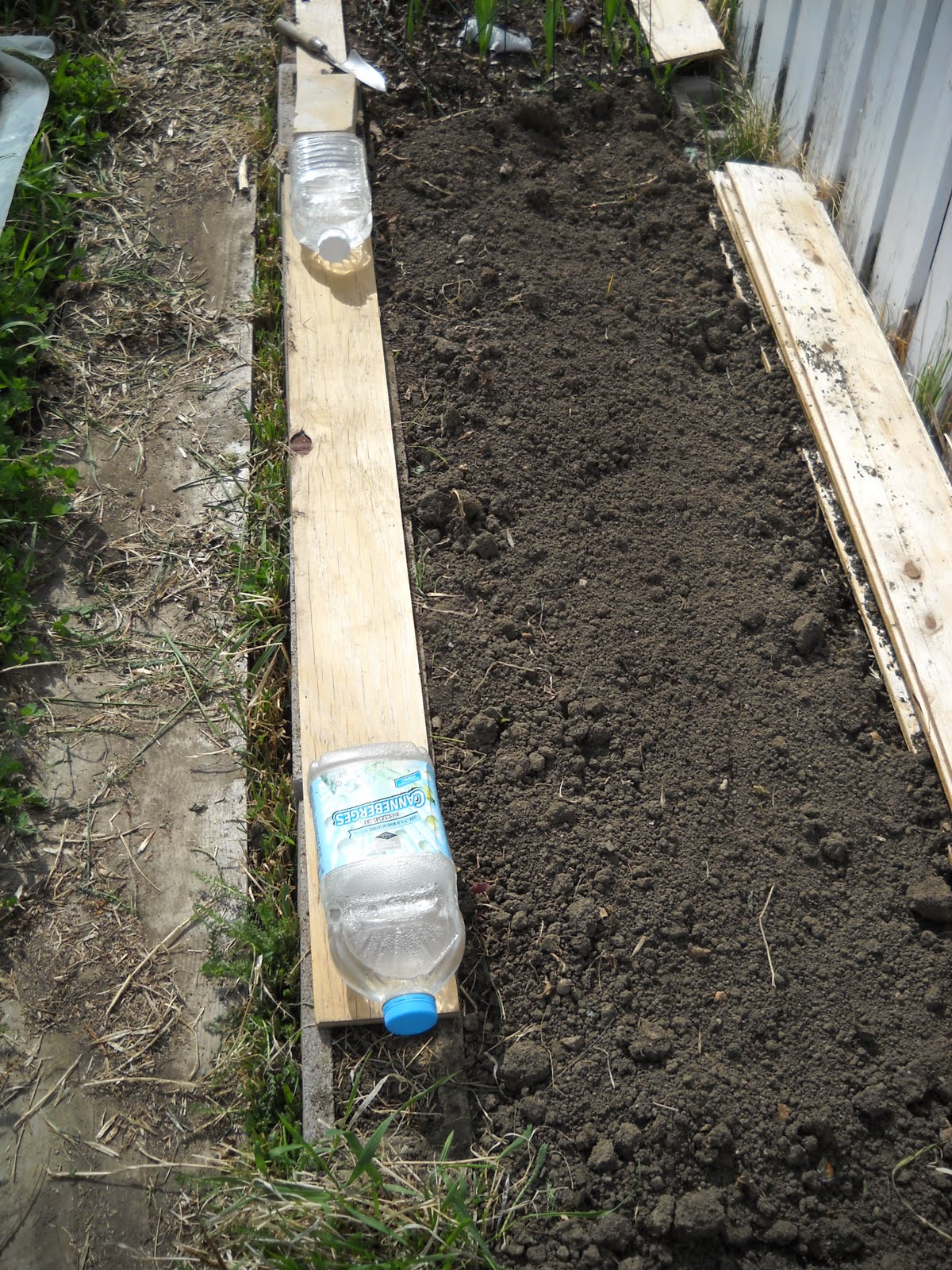
If only I could learn to like quack grass, how happy I would be, and how successful I would feel.  The large, wide, soft blades grow quickly in the spring and spread rapidly by underground rhizomes.  It's a lush grass, especially at this time of year when so few species are making serious contributions to the landscape.  If a cow wandered into our yard she would salivate at the site of these generous tufts.  If left alone, the grass would gradually succumb to ecological succession as other species replaced it.  My big problem with quack grass is not its competitive spirit, but those rhizomes.      A blade emerges in the middle of a patch of tiny carrot tops and I don't dare to pull it for fear of the entire rhizome network coming with it and disturbing the carrots.  Yet, if left there, it becomes a shade-creating, water hogging competitor as well as an energy source for the rhizomes as they tunnel onward toward the beets.   One preventative measure started yesterday was to cover the bricks that surround our garden beds with lengths of board in an attempt to starve the vegetation to death.  It first required some work to dig out roots so the board could lie flat on the bricks, but one small section is now in darkness.  It's a risky investment of time; I did have better things to do.  If only I could trust the killer chemicals.

Dandelions began rearing their deceptively pretty heads a few days ago.  It makes them easier to find on the lawn and instills a sense of urgency approaching panic.  It almost flashes a countdown, akin to a pedestrian traffic signal, to the moment when the yellow head turns to fluff and sets off to conquer new lands that are not far enough away.  The pointy right-angled extraction tool makes removal somewhat easier, if you don't mind having holes all over the place, but it's still hard to keep up with them.  I also feel some ambivalence about removing the plants rather than making daily rounds of flower-picking.  It seems that some ground nesting bees like to dig their nests under the spreading leaves of plants like dandelions, which provide some protection from the elements and from predators.  Who in their right mind would deny a good home to a bee?  Being a steward of the earth is not an easy gig.

At last I put a deadline on destruction: "At two o'clock, I will put down the shovel and do something constructive".  By the end of the day the lattice above the greenhouse entrance was in place, a task I did not find the time for last year.  The grapevines have something to reach for now.  This felt like success, and I'm quite motivated to feel that again.