Friday, 13 July 2012

Crispy critter

Since when is 30C considered hot?  I thought it was a normal summer temperature.  We have been watering the vegetables during this warm, dry spell, but I expect the perennials to last a few days longer with their deep roots and whatever climatic adaptations they should have if they are sold to southern Albertans.  First year transplants are an exception; I have been fussing over this year's newcomers.


july 2


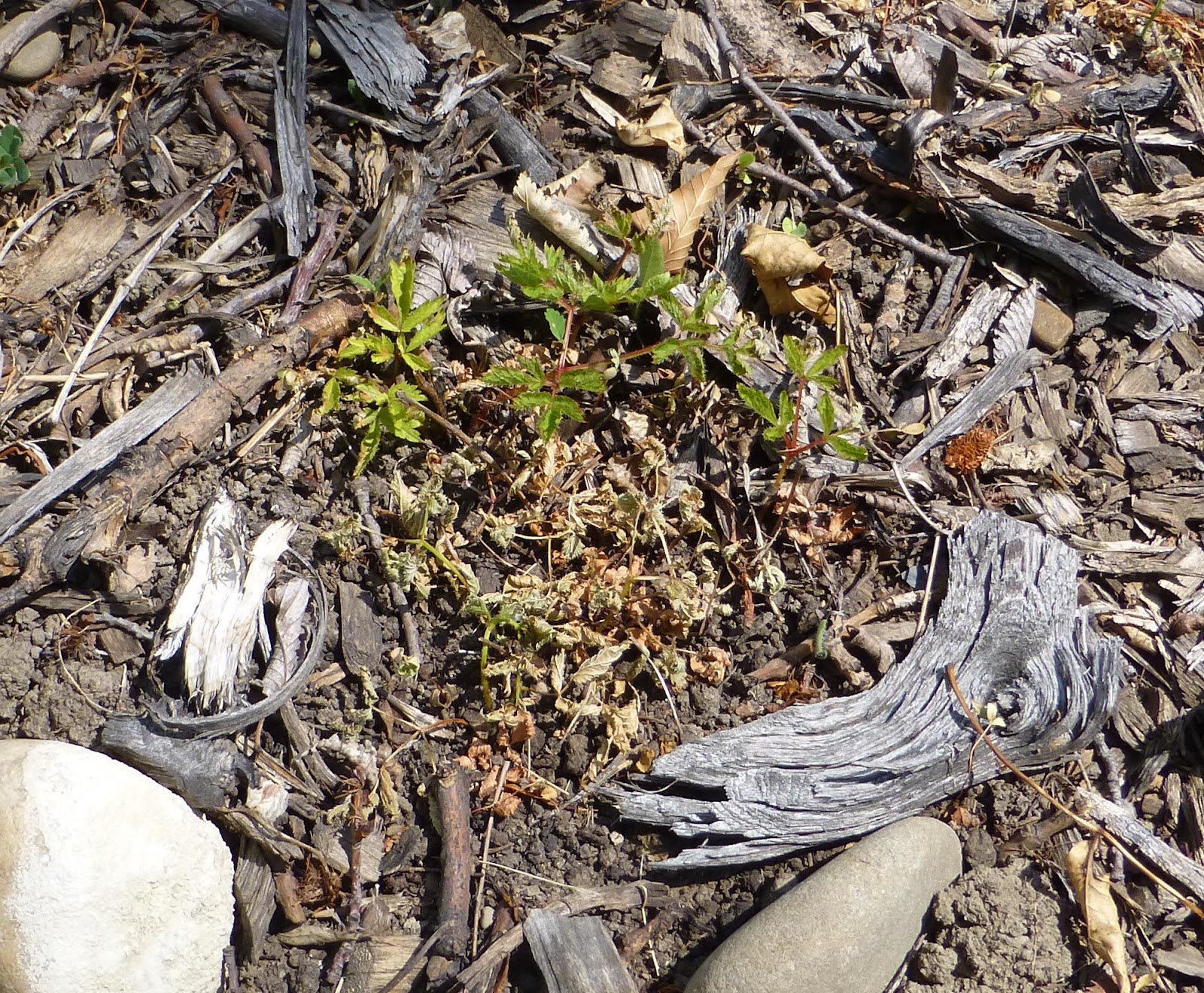
This dwarf astilbe was introduced last year.  It shriveled up early, well before the end of summer, and I was surprised to see it return in the spring.  It remained small and low, no flowers expected this year, but looked healthy, until Tuesday.


july 12


As is turns out, astilbe is a shade plant.  I guess I placed it thinking the spot qualified as partial shade; it's time to re-examine that.  This spring's caterpillar activity has made the front yard a little sunnier.  Had I remembered the shade preferences of my plants, though, I might have taking more care to see to their water needs through these extra warm days.  My bad.  The garden needs a little more idiot proofing.


Thursday, 5 July 2012

Thanks, Mom!

Sometime in the last decade, my mother began writing a cheque on my birthday equal to the number of years that I had managed to survive outside the womb.  The cheque arrived this week, but I knew it was coming and did my shopping on the weekend. Here is what a woman of my age can buy with her birthday money:

Creeping lamium (L. maculatum 'Pink Pewter')  A spreading patch of small silver leaves with a narrow green edge.  salmon-pink flowers appear in spring, then continue off and on until fall. Fairly tolerant of dry shade.  ~jeeperscreepers.info

Single painted daisy (Tanacetum coccineum Robinson's mix) Foliage is bright green and ferny with upright stems bearing loads of single yellow-eyed daisies, in shades of white, pink or crimson red.  ~ Heritage Perennials

Alpine strawberry (Fragaria vesca 'Yellow Wonder)  A unique and rarely offered yellow-fruited form of the European Wild Strawberry. Tiny white flowers appear all season, followed by small cone-shaped creamy-yellow fruit, the tastiest of all strawberries.  ~ perennials.com

Rock soapwort (Saponaria ocymoides) Smothered in stunning pink flowers at the ends of the stems from mid to late spring.  Its round leaves remain emerald green in colour throughout the year.  ~Northern Classics

Variegated periwinkle (Vinca minor 'Ralph Shugert') Forms a dense mat of glossy dark green leaves edged with white, and a display of bright blue flowers in spring.  Tolerates dry shade.  ~ Heritage Perennials

Fern-leaf bleedingheart (Dicentra 'Candy Hearts')  Forms a vigorous clump of powdery blue-green leaves topped by clusters of delicate dangling heart chaped flowers in a dusky rose-purple shade.  ~ Heritage Perennials

Creeping Jenny (Lysimachia nummularia) A vigorous spreading groundcover, useful in difficult shady situations.  Forms a mat of bright green leaves studded by yellow flowers in late spring.  Best as a lawn substitute.  ~jeeperscreepers.info 

Daylily (Hemerocallis 'Stella de Oro) By far the most popular Daylily selection of all time.  Forms a dense clump of grassy green foliage, with upright stems of fragrant, golden-yellow trumpet flowers.  ~ Heritage Perennials.

Moss phlox (Phlox douglasii 'Crackerjack')  A low mound or cushion of dark green needle-like leaves, smothered by tiny flowers in late spring. Very compact variety, with a grand display of bright starry magenta-red flowers.  ~ rockstarplants.com

perennial birthday gifts
A few specimens didn't look great, hence the group photo instead of individual head shots.  They may not look like much, but give them time.  See below what happened to my little bloody dock from one year to the next.  Perennial plants are a good investment.  Thanks, Mom.  

bloody dock 21-07-11
bloody dock 24-06-12
Last year I spent the birthday money on plants, but not at a typical garden retail outlet where customers generally leave with labelled pots.  Through no fault of my own, I was late getting to a sale of native plants at the museum; they were starting to pack up.  So I quickly yet thoughtfully chose ten plugs and brought them home.  Hours later, I thought I still knew what five of them were, and was fairly certain I knew which five others I had chosen, but did not know what was what.  Still don't.  One flowered this year and evidently it is fleabane.  I would not have chosen fleabane.  Only the Jacob's ladder and blue-eyed grass are for sure now; the rest - I forget what I even thought they were at one time.  It's okay to have a few mysteries.

As a gardener, my gratitude to Mom extends beyond her support for my plant shopping sprees.  From as early as I can remember, we had a vegetable garden on the hill that sloped down from our house toward the Northwest Arm in Halifax.  There was a large rectangle here, a smaller one over there, a couple of more squarish patches.  We (I'm sure I helped sometimes) dug through the soil with a fork each spring, tossing out the numerous rocks hat had floated to the surface since the previous spring.  We planted in straight rows across the beds, leaving the prescribed space between rows and mounting the seed package on a stick  to announce the coming vegetables.  Beans, peas, beets, carrots, tomatoes, peppers, potatoes, corn, radishes - I believe we grew all that, and more, but I can't remember.  Marigold transplants were placed at the periphery to foil insect pests.  Rhubarb sat at the top of the large bed.  Raspberries were eventually installed on the other side of the yard.  I think we had asparagus at one point.  We had a compost pile; Mom even made compost tea back in the seventies.  I don't recall weeding or watering the garden. or even harvesting.  Maybe I didn't help out after all.  Maybe I learned nothing about gardening from the family garden.  Today I dig as little as I can, arrange plantings more in blobs than in rows, and leave "weeds" in the ground until I'm sure they don't have a role to play there.  My present garden is chaos compared to what I grew up with.  Regardless of the variation of style, though, I think the most important bit was being socialized toward growing food.  What my parents gave me was the notion that having a vegetable garden is something you do, like going to church and reading at bed time.  It's normal.  It's expected.  It's simple.  Thanks, Mom and Dad, for giving me that.


Monday, 2 July 2012

"What's Goin' On" and on

carrots with onion buffer, plus rogue dill and parsnip
Don't plant carrots and parsnips together, says The Vegetable Gardener's Bible.  These warnings don't tend to define "together" very well.  I try to put the bad companions in separate beds, but sometimes it isn't practical, so maybe I sow a row of lettuce (that great peacekeeper that is everyone's good companion) between the enemies and hope that's enough.  Both carrots and parsnips are comfortable with onions, ergo a double line of yellow onions between should stifle animosities.  This bed of carrots was sown sometime in April and has attained lush ferny tops.  In June I realized this was all I had planted for carrots (I wait to see what spaces are left after transplants and then forget) and started hunting around for small patches to sprinkle a few seeds - between tomatoes on the south edge of one of their beds and in the pea/bean/shallot bed, again placing a buffer (the carrots themselves this time) between two bad companions.  Just a few days ago I opened several packages of seeds of various varieties and ages and scattered them around the onions in the zucchini bed.  Besides these, there are a few volunteers around.  Like the parsnips, some might be in their second year.

corn and carrot flowers
Last fall I did leave one patch of tiny carrots to become this year's seed carrots.  They are huge and already flowering, dwarfing the adjacent corn stalks.  We have grown corn three times in the past and have had one or two good ears in all.  It's not the region - Taber, 50 km away, is famous for it's corn.  It has a Corn Fest in August.  I have gap-toothed corn and earwigs.  Too stingy with the fertilizer, perhaps?  Apparently unable to learn from past experience, I am again growing corn, with the seed variety that didn't work out before.  A vacant garden space with no plan for it, a box of leftover seeds (I can't just throw out perfectly good hybrid seeds) - what could be the harm?  It looks good so far, though already leaning from the high winds.


sunchokes
Sunchokes are already at shoulder height and leaning out into the pathway from one of their beds.  That group is so thick I have given up searching for weeds.  It might be just a solid block of tubers below the surface when we start digging them up.  I look forward to seeing how tall the stalks get this year.  The plants in the other bed, the former everlasting sweet pea bed, are the same height, not quite as dense.  Sweet peas keep trying to regain their place and I keep pulling off whatever growth I see.  Now that the sunchokes are getting bigger, though, the sweet peas will find they can get a lot further undetected.


raspberry thicket
As for fruits:
Haskap berries were tart and delicious and are now done for the season.  I prefer the larger berries of the short Cinderella variety and wish it would grow into a bigger bush.  It does have a rooting pot on it, so I hope to have a successful clone plant by the end of the summer.  There are also two rooting pots on the Berry Blue and one on the new Borealis.  The latter should be removed because the branch has clearly perished.
The first ripe strawberry was spotted June 15 and the first raspberry June 28.  There is a big feed of raspberries to come, if we dare enter the thorny mess that has developed.  The task becomes more intrepid when bees are pollinating flowers of the later variety of berry.  No Nanking cherries, no apples, no pears.  We don't know why.  Very sad.  The forecast for grapes is still good, as long as Barry can hold off the hordes of hoppers.

thyme and sage, and chamomile
A few small sage and thyme plants started in 2011 were uprooted from their original location and placed between the chives and walking onions last fall.  All survived the winter and are flowering now.  Some chamomile seeds have landed in the same area and will be allowed to grow as long as the flowers are not in the way; we don't want to risk stepping on bees in the pathways.  Dill is again everywhere.  I went on umbel patrol three days ago and will have to make another round today, even removing entire plants.  Cilantro self seeded itself generously last year.  It's a fragrant stroll past that bed as the leaves release an aroma from the lightest touch.  Somewhere on the interweb was a suggestion to freeze herbs in olive oil in ice cube trays.  Worth a shot.  A new herb for us this year is rosemary.  One year I started rosemary from seed and always had difficulty finding it after transplant  because it stayed so small.  This year I again started with seeds, but cleverly placed them in a large pot instead of the ground.  The two are still less than an inch tall, but they won't be accidentally weeded.  Nevertheless, we picked up a larger plant, maybe eight inches tall, at Greenhaven, to fill a container vacancy (the store was out of tomatoes and cucumbers at that point).  It's a "tender perennial".  Guess we'll find out how tender next spring.
garden cress going to seed


Miscellaneous:
Rhubarb is viable on the boulevard, though not nearly as large as it was when it lived by the water tank overflow in one of the sunniest parts of the back garden.  The two uprootings may not have helped.
Lettuce has been great, but is reaching for the sky.  More has been sown, in faint hope of tender summer leaves.  Cress bolted ages ago, yet it looks lovely leaning against the squash ladder with its tiny white flowers.  I just can't remove it yet.
giant self-seeded radishes
Radishes planted early in the front yard went straight to seed.  Those few planted among the peas in back have been fine.  A couple of volunteers dug up in the tomato bed are outstanding.


Have I covered all the edibles now?

Saturday, 30 June 2012

More "What's Goin' On"

peas in cages in the back yard
Snow peas have been on the menu for less than a week.  Plantings were staggered by probably 3 or 4 weeks - March 31 in the front yard and twice in April in the back (wish I'd made notes at the time) - and the pods all came out at the same time.  I have seen this with pole beans before; I finally give up on the first planting, poke some more beans into the ground, and watch them all come up at once.  Lesson learned: peas can be sown "as soon as the ground can be worked" (March), but they won't feed us any sooner than if we sow in late April. Any fine weekend in between will do. Strong wind a few days ago knocked over the vines that had grown beyond the tops of their cages. They are still alive and well, but won't stand erect again and are going to get all tangled up in themselves now. Barry has been picking the pods and reports that front yard pods are smaller than backyard pods. Less sun, more wind, shallower soil - I'm glad they are doing so well. Shell peas in cages have blossoms now, those on the fence, sown later do not. They also haven't climbed nearly as high, a difference I am not sure is due to their respective ages. I'm curious to see if the two groups eventually reach the same height.

scarlet runner beans
There are six pole bean structures this year, the most we have ever had.  New poles had to be found.  Though I did anticipate using the stalks of a few tall sunflowers from last year, they were  broken before I had a chance to get them out of the ground.  They grow in the alley, so are vulnerable to misfortune at the whims of deer or other creatures.  I'll try pulling them up before winter this time around.  Meanwhile, I'm trying out some lengths of plastic conduit (used as row cover support last year).  They appear to be acceptable for climbing, but don't contribute to a stable structure.   Anyway, I sowed two structures with scarlet runner, three with Ina's white, and one with rattlesnake beans.  The first two are well underway, winding toward their respective peaks and revealing petal colour in their axillary buds, while the rattlesnakes are slower, just starting to find their poles and having rudimentary buds.  There was a bit of a slug problem in that area.
scarlet runner bud
Bush beans - Maxibel French Filet and Orca - grew up fast and are now looking crowded on opposite sides of the pea fence.  Those were sown in May and and the buds are about to open.  Yesterday I filled an empty spot at the end of the Swiss chard with two rows of each.  I'm pretty sure there is enough time.

garlic from bulbils

garlic from cloves
The garlic patch has three sizes of plants this year.  I haven't a clue what the varieties are (they could all be the same one), but they are different stages that were planted last fall.  The smallest are from bulbils, the seeds of the flowers (or scapes), the medium stalks are from teardrops, the root bulb that grows the first year from a bulbil, and the largest are grown from single cloves.  I pulled up one of the latter recently and wish I hadn't.  It was interesting to see the tiny cloves forming inside the root bulb, but now we won't have that full-sized bulb in August.  The teardrops should produce small bulbs.  The bulbils may even produce small bulbs instead of teardrops.  It depends on the variety.  Surprises await.  Scapes are growing and curling on the two larger groups.  Today I cut a few that had done a full circle and will try them in an omelet tomorrow.  Generally, leaving the scapes on is expected to reduce bulb size, because plant energy is going into making bulbils instead of bulbs.  I will leave a few scapes in place and check whether this is true for my garlic.  Plus, I want some bulbils.
walking onions

Also in the allium group, we have yellow onions, shallots, chives, and walking onions.  Yellow onion sets were poked in the ground between carrots and parsnips in one bed (see the Parsnips post) and much later inserted into the area left unclaimed when some zucchini plants failed.  The later ones are still less than finger height, and may, like the ground cherry, require some protection from encroachment.  Shallot seeds went into the end of a raised bed meant for peas and beans.  The legumes still followed, cutting short both ros of shallots. I'd say only half of the seeds germinated and they are now a few inches tall, thin and delicate, like baby chives.  Onions and legumes are said not to be good companion plants, but we have volunteer peas coming up among the garlic and neither are visibly suffering.  Chives and walking onions carry on beautifully, tough perennials that they are.  The chive flowers have mostly lost their colour and the walking onions have scapes on scapes.  Very interesting formations.

We also have two onions in a container: one was found this spring in last summer's onion patch, the other had begun to sprout out of boredom during a long stay in my father-in-law's refrigerator.  That one has already made a scape, the other is just being.

More to follow.....


Friday, 29 June 2012

Time now for "What's Goin' On"

The post title is amusing only to those who received cable tv channels from Maine in the 70's and 80's.  If you are hoping to read about upcoming events at the Bangor Mall, you are going to be sorely disappointed here.

It's just over a month since my hasty post about what was going down (and coming up) in the garden, so here is an update.

Tomatoes were all transplanted by the first weekend of June and all except one have survived the onslaught of flea beetles.  Another one, planted upside-down, appears to have succumbed to a broken stem suffered during high winds.  All others are looking sturdy.  They always look terribly weak and vulnerable after transplant and toughen up incredibly fast.  They have already had their first axil pruning.  Peppers, melons, cucumber and basil are all in containers.  I've put one container of watermelons, one of peppers, one tomato in the greenhouse to see how they like it there in the summer.  All potatoes successfully sprouted and have blossoms already.
defiant tomato
potato bed june 24

costata romanesca
 june 9


Only three zucchini plants made it to transplant and they are now hanging over the sides of their bed.  (The grim hue of the early photo is a result of me forgetting I'd been playing with the white balance on my new camera.)  I'd better remember to measure the full grown diameter this year; one plant has already shaded the ground cherry I thought was a reasonable distance away from it.  Fencing and a guard iguana have been installed to protect the ground cherry.
costata romanesca june 28

red kuri getting a grip
Four winter squash plants made it to transplant: one Uncle Dave's Dakota Dessert and three Red Kuri.  We got one large and excellent Red Kuri gourd last year and would like to have more.  Uncle Dave's is there for back up.  The squash ladder worked out okay in 2011, but had to be moved for the sake of crop rotation.  Squash are in the "heavy feeder" group.  In moving the ladder, I also turned it, for some reason I don't recall, and the plants were place on the south side of the mesh they are meant to climb.  Of course they all tried to vine south, away from the mesh.  I applied some encouragement yesterday and hope they soon get a better grasp of what they are supposed to do.
beets and chard undercover


Beets and Swiss chard are lush and almost blemish free in their covered bed.  It's not a tight seal, but enough to drastically reduce access for leaf miners.  It has been years since we have been able to just rinse and slice the Swiss chard without first tearing away the scabby bits.  With the row cover protecting it from heavy rain and pests, we barely need to rinse it before eating.  Downside, the bed would look more beautiful without the cover (but only until the leaf miners found it).  The section with beets (foreground) has grown especially bulgy. I might have to start eating around the edges.


To be continued......

Thursday, 28 June 2012

Parsnips everywhere

the parsnip that started it all
It started in 2008, when I sowed my first parsnip seeds.  I wasn't that excited about it, associating parsnips with turnips, which I don't care to eat.  We dug up most of them the following spring but I left one in the ground to see what would happen.  In spite of my lack of experience, I knew it was a biennial plant and that something would happen.  Very much to my surprise, it grew to be almost as tall as me and branched out with great umbels that grew seeds.  I was in awe of it, much as I had been of bolted lettuce plants the first time I saw them.  It was some time after the seeds had developed sufficiently to produce new plants that the flower blew over in a storm, falling directly south toward the the fence.  No doubt there was a great scattering of seeds that night, but there was also the dragging of the plant off to the compost after we realized the stalk could not be righted.  Still, we had no idea how far those seeds had been flung.

In the spring of 2010, parsnips sprouted from the lawn.  They still do.  They emerged around the two bee balm plants where the flower toppled and along the periphery of that side of the garden.  I let them grow, thinking of them as potential food.  One of the volunteers growing right next to the cinder block border of the garden was our prize parsnip that year.  It was a huge effort to uproot it from where it had burrowed under the brick.  Others weren't worth picking; the next year they became flowers.  We let a few of them go, if they weren't in the way.  We had to remove one that grew to overhang a narrow pathway.   This was due to the ant hazard.  Ants find parsnip flowers to be great range land for their aphid herds.  You don't want to have to brush past a plant where defensive ants loiter at neck height.

What happened with the 2011 flowers, I don't know.  I thought we carefully removed all the seeds before they had a chance to escape.  Still, seeds got around.  The wind may have blown them off when we weren't looking.   2009 seeds from the distributed compost could have germinated.  I wouldn't put it past the ants; they love to carry stuff around just to show off their impressive jaw strength to body weight ratio.  There are now parsnips growing in every bed of the main garden.  I don't think they have infiltrated the new raised beds.

parsnip in bee balm

This is the smallest bee balm plant with a tiny parsnip.  It's difficult when they get in among the roots of perennials.  We pull parsnip leaves from the larger bee balm plants every week.  One even managed to make a flower before we caught it.  The root has to be exhausted eventually, I hope.


parsnips with lettuce
This is one of the beds where I sowed parsnips in 2011.  They did not do well.  I can't tell yet whether these are first or second year plants.  Though it's logical that last year's planting would yield second year plants here, I don't see any sign of a flower yet.  I think it would be happening by now.


parsnips with brussels sprouts

  Now here is a nightmare for some children: two of their not so favourite vegetables side by side.  I feel quite confident that these are growing from seeds this year.  I had snow peas and carrots in this section last year and was weeding like a fiend to keep sow thistle from going to seed here (for all the good that did).  Would have noticed parsnips.  I haven't checked The Vegetable Gardener's Bible to see if these two are good companions.  They are both doing fine.


parsnip with sunchokes
The sun chokes are growing so thick in this bed, it may be difficult to see the parsnip that is happily situated on the sunny side of the rectangle.  It's huge.  For a while I was thinking that anything that got that big that quickly had to be second year.  But I don't remember when this one started.  Another wait and see.  It will be interesting to see how deep it can grow.  The bed was created on top of lawn, so the root only has about eight inches to go before it hits the lovely hard packed clay substrate that we enjoy so much in Lethbridge.

They are found among the peas and pole beans and tomatoes, and growing out of the sides of the mounded beds. They are not fussy about where they grow or how deeply the seeds are planted.   All they need is water, light and space. With all the pests we find in the garden, nothing goes for parsnip leaves or roots. I have come to enjoy eating the roots, especially if prepared with butter and garlic. Somewhere I read that the leaves were edible, but then Barry (after I encouraged him to try eating a leaf) found several sources that say they are poisonous and can cause burns on contact with skin. I always wear gloves in the garden anyway.

parsnips with intent, and onions
I did sow a bed with parsnip seeds in May, from 2009 seeds.  Intended to do more when I figured out where they could go, but never did get it done.  This will not be enough.  Though there is space available, there is not enough growing season left.  Therefore I am leaving all the volunteers in place until they sprout stalks and umbels.  They may even do better than the mass planting, which is due for a thinning.  So why not just shake a couple of flowers over the entire garden in late summer and let them grow where they like?  Mainly because I want to know exactly where to dig for them in the winter, and because once I find a parsnip growing in the spring, it's hard to sacrifice it to make room for a beet, and because they might take over the planet.

Sunday, 17 June 2012

Animal Farm

"Indy, why does the floor move?"  In Raiders of the Lost Ark, it was snakes.  When the ground moves on my street, it's usually ants.  Sometimes I dig them up by accident and a shiny black slick rises to the surface. What's the going commodity price on a barrel of ants? I wonder.  Occasionally there is an almost imperceptible wave across the rock garden.  Something is in motion, but you have to look closely to see that it's ants on the move.  I suppose they get restless by times.  The other day I lifted a bucket that had been left too long in one spot.  The ants have no sense of the temporary nature of a plastic bucket.  The underside had an outer rim that elevated the bottom of the bucket just enough to make it the roof of a lovely ant nursery.  I ruined everything.  Well, not quite.  I could have ruined everything, but instead of viciously stomping on their baby sisters (which look very much like toasted puffed rice cereal), I took a video of the ants hurrying them to underground safety.  That's about all the attention the ants have received from us lately.  If they want to distract us from the other animals in our yard, they will have to be a lot more trouble.

It's caterpillar season again.  We find forest tent caterpillars ascending the trunks of green ash trees on the boulevard.  Barry has banded these trees with fiberglass insulation and tanglefoot, and ventured as far as his ladder will reach to remove any visible (and accessible) clusters.  But the trees are huge.  Out of reach, thousand of caterpillars munch through the leaves and defecate on the ground, the sidewalk, vehicles, formerly clean laundry hung out to dry, flowers and foiliage in the front garden.  I suppose the vegetable garden is getting a little more sun this spring, with most of the leaves of the big shade tree having been processed into little black granules and dropped to the ground.  There is a green ash not far from here that has been completely defoliated.  A few crispy rolled up leaves dangling from one twig were the only evidence that it wasn't dead.  It is said that trees can recover from complete defoiliation, and we have seen some new healthy leaves emerging.  But can they do it year after year?
It's not just the huge trees.  The apple tree is a wreck and the pear tree is better but still mangy.  The critters are also into the haskaps, strawberries, and even the new cotoneaster hedge, whose tiny leaves you would think are not even big enough to roll up into a shelter.  And the dangling of the younger larval instars (as seen here on the water tank)!  The air is thick with them by times.  They are unavoidable.  As we headed out on a bike ride (it was nice to have a few hours away from tall trees), Barry observed a mobile of caterpillars spinning and swaying, glowing in the morning sun.
We are trying to do our bit to stop the devastation, with the afore-mentioned tanglefoot plus Btk and Trounce and a knife and a fly swatter and electric bug zapper rackets and our shoes, even fingers in a pinch.  Greenhaven was sold out of Btk today, but there are rumours that Country Blooms still has some.  How long before it's only available at inflated black market prices?

Leafhoppers sucked the life out of our grape and Virginia creeper leaves last summer.  I can't see in past blog posts that I recorded this, which is quite disappointing because I would like to know when it was they overwhelmed us and caused us to resort to using the Shop-Vac.  This photo was taken mid-August and looks to be early in the battle.  They made short work of the leaves at the time, but the vines were still able to produce grapes.  Now we see them in June.  Barry has been diligent with the soap spray, trying to nip this plague in the bud.  The tricky part is getting to the underside of leaves (where the hoppers feed) of vines making their way across the greenhouse roof.

Another pest that seems to have shown up early is some form of flea beetles.  These have always shown up en masse late in the summer, usually on squash leaves or bolted radishes, where they weren't going to have much effect on garden production.  I don't recall seeing them in June before, and not on tomato leaves.  It is likely a different kind than we have had; there do seem to be species that go for different plants.  Anyway, there they were last weekend, chewing holes in the wee tomato plants.  More work for the insecticidal maniac.  I left straw mulch on the garden beds over winter.  Is this a kindness to pests?


There has also been some clandestine eating of pole beans and bush beans, but these are one-plant-at-a-time type attacks, and they were due for some thinning.  May be we should just grow onions and parsnips.  They seem to be invincible.  Or maybe we should give in and call these animals "livestock" instead of "pests".