Sunday, 17 June 2012

Animal Farm

"Indy, why does the floor move?"  In Raiders of the Lost Ark, it was snakes.  When the ground moves on my street, it's usually ants.  Sometimes I dig them up by accident and a shiny black slick rises to the surface. What's the going commodity price on a barrel of ants? I wonder.  Occasionally there is an almost imperceptible wave across the rock garden.  Something is in motion, but you have to look closely to see that it's ants on the move.  I suppose they get restless by times.  The other day I lifted a bucket that had been left too long in one spot.  The ants have no sense of the temporary nature of a plastic bucket.  The underside had an outer rim that elevated the bottom of the bucket just enough to make it the roof of a lovely ant nursery.  I ruined everything.  Well, not quite.  I could have ruined everything, but instead of viciously stomping on their baby sisters (which look very much like toasted puffed rice cereal), I took a video of the ants hurrying them to underground safety.  That's about all the attention the ants have received from us lately.  If they want to distract us from the other animals in our yard, they will have to be a lot more trouble.

It's caterpillar season again.  We find forest tent caterpillars ascending the trunks of green ash trees on the boulevard.  Barry has banded these trees with fiberglass insulation and tanglefoot, and ventured as far as his ladder will reach to remove any visible (and accessible) clusters.  But the trees are huge.  Out of reach, thousand of caterpillars munch through the leaves and defecate on the ground, the sidewalk, vehicles, formerly clean laundry hung out to dry, flowers and foiliage in the front garden.  I suppose the vegetable garden is getting a little more sun this spring, with most of the leaves of the big shade tree having been processed into little black granules and dropped to the ground.  There is a green ash not far from here that has been completely defoliated.  A few crispy rolled up leaves dangling from one twig were the only evidence that it wasn't dead.  It is said that trees can recover from complete defoiliation, and we have seen some new healthy leaves emerging.  But can they do it year after year?
It's not just the huge trees.  The apple tree is a wreck and the pear tree is better but still mangy.  The critters are also into the haskaps, strawberries, and even the new cotoneaster hedge, whose tiny leaves you would think are not even big enough to roll up into a shelter.  And the dangling of the younger larval instars (as seen here on the water tank)!  The air is thick with them by times.  They are unavoidable.  As we headed out on a bike ride (it was nice to have a few hours away from tall trees), Barry observed a mobile of caterpillars spinning and swaying, glowing in the morning sun.
We are trying to do our bit to stop the devastation, with the afore-mentioned tanglefoot plus Btk and Trounce and a knife and a fly swatter and electric bug zapper rackets and our shoes, even fingers in a pinch.  Greenhaven was sold out of Btk today, but there are rumours that Country Blooms still has some.  How long before it's only available at inflated black market prices?

Leafhoppers sucked the life out of our grape and Virginia creeper leaves last summer.  I can't see in past blog posts that I recorded this, which is quite disappointing because I would like to know when it was they overwhelmed us and caused us to resort to using the Shop-Vac.  This photo was taken mid-August and looks to be early in the battle.  They made short work of the leaves at the time, but the vines were still able to produce grapes.  Now we see them in June.  Barry has been diligent with the soap spray, trying to nip this plague in the bud.  The tricky part is getting to the underside of leaves (where the hoppers feed) of vines making their way across the greenhouse roof.

Another pest that seems to have shown up early is some form of flea beetles.  These have always shown up en masse late in the summer, usually on squash leaves or bolted radishes, where they weren't going to have much effect on garden production.  I don't recall seeing them in June before, and not on tomato leaves.  It is likely a different kind than we have had; there do seem to be species that go for different plants.  Anyway, there they were last weekend, chewing holes in the wee tomato plants.  More work for the insecticidal maniac.  I left straw mulch on the garden beds over winter.  Is this a kindness to pests?


There has also been some clandestine eating of pole beans and bush beans, but these are one-plant-at-a-time type attacks, and they were due for some thinning.  May be we should just grow onions and parsnips.  They seem to be invincible.  Or maybe we should give in and call these animals "livestock" instead of "pests".

Sunday, 27 May 2012

All dig, no write

Work.  Dig.  Move dirt.  We are turning into ants.  It's hard to find the time, and peace of mind, to write about it.  Ants don't write.  They live in the moment.

In spite of the mild winter passed, we still get frost warnings well into spring.  The seedlings can stay in the greenhouse tonight, but transplanting has to wait until next weekend, when we hope it will be safe.  Most of them look too small to be out in the wide open beds anyway.  They couldn't even survive a sparrow attack.

Annuals:  We have planted lettuce, cress, onion, parsnip, carrot, beet, Swiss chard, peas, bush beans, pole beans, shallots, Brussels sprouts, radishes, corn, potatoes.  Not exactly in that order.  Only the shallots are still hiding.

Biennials:  A small patch of carrots that amounted to barely anything last summer is now growing quickly into adulthood.  I expect they will be forming flowers within a month.  Hope I can figure out what variety they are.  The row of parsnips  biding their time next to shell peas last year was also set to take off, but have been diverted to the compost track.  A patch next to the back alley will be allowed to grow tall, alongside other high achievers like sunflowers and sweet peas.

Perennials:  Rhubarb has survived it's removal to the boulevard, where it shares its quarters with a solitary sun choke that was left behind.  Sun chokes have also emerged where they are expected to, in two back yard beds, starting two or three weeks ago with the plants not harvested.  Tubers that were dug up and replaced in the ground are still sending up shoots.   We've had our very meagre haul of asparagus and are now letting the spears grow into ferns.  Garlic is growing in three different sizes, from cloves, bulbils and teardrops.    I hope some is ready to eat soon, because last year's stock is now gone.  (Maybe garlic shouldn't be classified with the perennials, but it would just keep going if we left it in place.)

Self-seeders:  Cilantro, dill, parsnips, carrots, peas, pak choi, Swiss chard, and borage are all showing  up where they weren't expressly asked to be.  It's fine.  Why should the gate crashing be left to only dandelion, creeping bellflower, quack grass, and sow thistle?

Fruit:  The first ripe haskap berries were spotted on Wednesday.  Some strawberry plants are blooming.  Raspberry canes proliferate and are developing proto-blossoms; fruit is a long way off.  Grape leaves are barely out and we can see flowers (minuscule bunches of grapes) already.    Nanking cherries had very few blossoms.  Apple tree had only one and is again ravaged by pests.  Pear tree blossomed but it's hard to tell yet whether any were pollinated.

In brief, this is how the black thumb's garden stands on a rainy last weekend of May.  As my working hours are reduced in accordance with the academic quiet time, and weekly scheduled activities promise a summer break, I hope to get back to more thoughtful and useful (and frequent) reports.

Sunday, 11 March 2012

Spring ahead

The onset of Daylight Savings Time.  The impending vernal equinox (nine days away!).  I said a year ago that spring never comes early.  Let me restate that: Spring had never come early following the six winters I had spent in Lethbridge.  I may have been jumping to a hasty conclusion. This weekend we have spent time working in the back yard, enjoying sun and mid-teen temperatures.  Leaves are emerging from honeysuckle stems and bloody dock roots.  A few of the ladybugs exposed when I cleared away the old Swiss chard plants were ambulatory.  Given the odd winter that has been, it's possible to believe that the weather will not turn severely cold again until after the growing season.  But it's impossible to be sure.  Mild weather is expected to continue for the rest of Winter, which may be long enough to convince some plants that it is now safe to grow.  There could be some sad stories of frost-bitten ambitions in the near future; it could all be just fine.  No point fretting about it.

While Barry toiled in the raised bed area he is creating, I filled some empty containers with earth.  Now we have 11 more containers for plants that like their roots warm, and we have a smaller dirt pile near compost as well as less clutter in the greenhouse.  Win-win-win.  Barry had the harder task of dismantling two garden beds surrounded by cinder blocks (now colonized by yarrow) and leveling the ground to put in a new raised be (and then three more).  I think it will be a huge improvement.  The long beds looked good last year, but on closer inspection, too much of that lush growth was peripheral weeds.

We harvested a few parsnips and sunchokes today - first homegrown food of 2012.  The arugula in the kitchen doesn't count because we haven't been eating it.  It's more like a chia pet.

Saturday, 17 September 2011

Tuber time

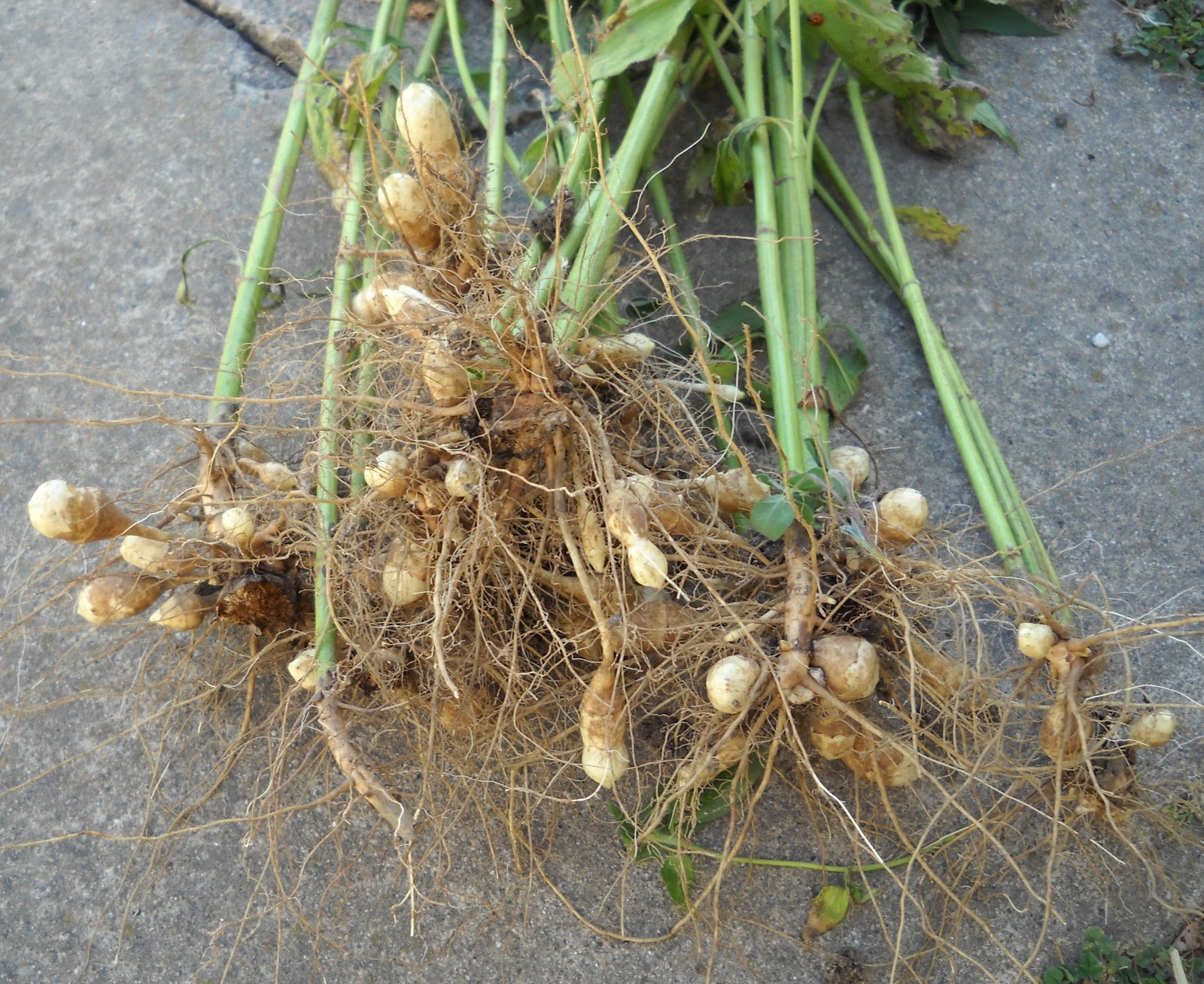
Our first sun chokes were planted on the boulevard, in a raised bed build on top of the lawn.  The site is subject to wind from the west and midday shade from the huge trees that line our street.  There was no opportunity cost to planting them in that location - we were not short of tubers in the other areas that were available - so it was no great mischief that they didn't thrive.  They grew to all of three feet tall (guessing) and were often limp, probably a result of the wind.  Meanwhile, their relatives that were lucky enough to be planted in sunnier places on the leeward side of the house have grown well over six feet tall and look chronically perky.  This morning I dug up the boulevard sun chokes, in recognition of their inferior performance and out of curiosity about what is happening underground.

Things were happening.  Most of the roots had developed a few small tubers.  After being pulled off the roots, they filled a single layer of a square food container (picture a Ziploc 500ml food saver).  Not much, possibly not even quite ready to eat (the tubers are said to be tastier after a hard frost or two), but I hope to give them a try tomorrow.  Hope they don't require peeling; there would be almost nothing left to eat.

The backyard sun chokes are finally, in the third week of September, indicating that they might flower before they freeze to death.  All summer I have been poking at their tips and finding infinite layers of leaves; now many of them have a tiny green disk like a sunflower, only a thousandth of the size.  Lately, I've had to reach up and bend the top of the stalk down toward me to see what's happening.  Until now, no flowers but usually a ladybug party.  We have ladybugs all over the garden this summer, like never before, but nowhere do they look so comfortable as they do in the sun choke leaves.


backyard sun chokes


Curiosity will drive us to try dig up at least one of these plants from each remaining location before winter.  Then we have to memorize the quality of the food until spring so we can compare and see if it's worth leaving them in the ground all winter.  I have little doubt that the seed tubers should be left in the ground, but we don't know about food.  We enjoy eating freshly dug parsnips in the spring.  Wouldn't mind having another crop like that.


All the potatoes were dug up yesterday.  The tops had mostly turned yellow, shriveled, and hurled themselves into the straw.  No further growth expected here.  The haul was okay, but really could have been better.  I expected them to go deeper; most of the potatoes were quite close to the surface.  I even went through the bed a second time this morning with a shovel, rather hoping I had missed more than a few.  I had missed just a few.  But, it's good enough.  We have probably as many potatoes as we will want to eat before they begin to deteriorate (we don't have ideal storage conditions) and I managed to stab a mere three tubers during the harvest process (my mutilation rate is normally much higher than that).  Soon the rattlesnake bean tower will be dismantled and I can go in and get the rogue potatoes from that bed.

Sunday, 4 September 2011

State of the garden - Labour Day weekend

Pea vines have turned brown, potato plants have keeled over, and a few squash vines have been chopped up for compost.  At the same time, scarlet runner vines continue to grow lush dark leaves and bright blossoms, parsnips are having a spurt of their own, and Jerusalem artichokes reach skyward, showing no sign of flowering yet.  Life cycles are all over the place.

Bee balm, borage, sunflowers and clover continue to nourish "our" bees.  Wasps seem to be more plentiful every day, hunting among the vegetables for prey for their young or chewing on the greenhouse wall to furnish their nests.  Delicate cabbage moths flutter about in twos and threes, pretty if only we can forget for a moment what they do to our crucifers.  Dragonflies hover, pace, and dart about within their invisible boundaries.  Haven't seen what they are eating.  It's a lively place.

September 2 brought the dreaded phrase "frost warning" back into our life.  Although Lethbridge was not mentioned in the report, there was a warning for Calgary, Okotoks, Magrath and Cardston.  Hard to see how it would be any different here, and the forecasted low was 2C (with "feels like -2C").  We survived unscathed and seasonal overnight temperatures have returned.  Sigh of relief.  I didn't think this would come so soon.

Wednesday, 31 August 2011

A change in the weather

It's the final day of August, a day which happens to be cool, wet and dark, as if summer disappeared literally overnight.  It didn't - warmth and sunshine will be back in a couple of days - but it feels that way.  It would be a good reminder, if I hadn't started thinking along these lines a week ago, that wrap-up time is approaching for much of the annual vegetable garden.  Don't want to leave it all to be done on a couple of blustery October weekends.

The pea vines are mostly brown, yet they still carry living green branches that bear pods and peas.  They aren't as sweet and tender and perfectly shaped as they were in July, but quite edible.  The same goes for beans, especially the rattlesnake pole beans.  After two or three good weeks they seem to go from immature to overdone without passing through an appropriate stage for picking.  So we put up with beans that are a little bulgier than we prefer.  I picked off a couple of shriveled pods from these sad Schweiserreisen plants.  If the seeds germinate, I can pick the rest and put this mess to rest.

Summer squash - zucchini and papaya pear - continue to bear perfect fruit even as their leaves are going yellow (and being perforated by slugs).  It's time to tie a "do not pick" ribbon around a few specimens to ensure we have some seeds for next year.  We grow less enthusiastic about giving away our surplus.  The stem on at least one winter squash has changed colour, which probably indicates that it's done. I could put it away and get the vine chopped up now rather than later.

Onion tops fell over long ago, but as long as they are green I keep hoping the bulbs will continue to grow.  Our onions never get as big as the set package promises.  Leaving them in the ground doesn't seem to hurt them, provided they aren't been set upon by pests.  We have found edible-looking onion bulbs while turning over the garden in the spring.  Garlic tops, conversely, are standing erect and are totally devoid of green.  The whole bed will be dug up when ground dries up a bit.  Some will be replanted, but in a different location.

Great seed-bearing versions of otherwise short plants have arisen and been felled.  Garden cress, pak choy, parsnip and lettuce seeds were collected last weekend.  Radishes are still in the works, if they survive the late summer onslaught of flea beetles.  Some of the Simpson lettuce seeds have been sown with hope that there is still time to grow leaves of a useful size.


Tomatoes are finally ripening - Tigerella, quickly followed by Tribe's Tobique, with San Marzano just starting and Longkeeper stubbornly staying green.  It's no wonder it keeps the longest if it's the last to ripen.  Not a hint of blossom end rot this year.  Is it the frequent watering, the straw mulch, the compost tea, the varieties? Controlled experiments take too long.  We just have to keep doing all of the above.


Potato plants are a bit yellow, a bit holey (slugs again) and very much in the way, having overgrown all pathways adjacent to their bed.  Barry dug up one end of the bed on Sunday, so we can more easily get from one side of the large garden to the other and we now have a large bag of potatoes for eating in the near future.  The tubers seem to keep better in the ground than in the basement, so we'll hold off further excavation for a while yet.  Besides, they might still be growing.

Carrots still have lush green tops and if we're really lucky, chunky little 3-inch roots.  The entire harvest is apt to fit in a bread bag.  We have eaten a few and found they have genuine carrot flavour.  If only they would be a bit more tender (and longer!).  They can be harvested and stored in the fridge as soon as the zucchini and beans clear out of there.  Or, they can stay in the ground until I lose my patience with them for growing so slowly.  (I like the idea of the Slow Food movement, but can't claim to be a disciple.)  Carrots sown under the rattlesnake beans have no doubt died of darkness; those among the white beans live, even if their roots are not substantial.  Since they are near the edge of the garden, they are probably the best candidates to be next year's seed carrots.

The largest of the beets have been picked, a few of them pickled.  It would be nice if the little ones left behind take advantage of the space they have to grow now.  Not entirely counting on it, but it would be nice. So many of the tops have been ravaged by leaf miners, I no longer even bother trying to save the good leaves for eating.  Swiss chard is marginally better in that respect; otherwise I would pull it all now.  Hoping that leaf miners die in the fall while beets and Swiss chard keep going.  Full of wishful thinking.

(Almost) everything else, in brief:
Pears are few and small, but acceptable quality
Raspberries are picking up speed
Red bee balm looks tired but could still attract a hummingbird this week
Grapes are hanging on and ripening, despite massive defoliation by leaf hoppers
Peppers, both sweet and hot, are growing green and shiny
Watermelons haven't grown in weeks (the softball-sized one we ate was very nice, though)
Two parsnip plantings are thriving, two not so good
The dominant hue of the red clover flowers is now brown
Basil has been regrowing nicely following severe cutbacks
We have some ugly little cauliflowers.  I might have to double-dog-dare Barry to eat one.

Summer has three weeks to go, officially.  However, September 1 is like New Year's Day for me.  Back to running, back to Toastmasters and clogging, on to music lessons and longer hours at the office.  Gardening season has to wind down, regardless of the weather.


Saturday, 20 August 2011

Progress notes

Today I removed from the garden:

Raspberries - still only a dozen or two per day and still extracted with care due to the bees avidly pollinating our future berries.
Pod peas and shell peas - just a handful all together, but I'm pleased they are still producing at all after a long spell of very warm weather
Scarlet runner beans - four or five only, and they are hard to spot
Rattlesnake beans - a big handful of the most delicious pole beans we've ever tried
Papaya pear squash - two perfect shiny yellow pears that went into the fridge; we ate the previous fridge ones for supper today
Zucchini - four good ones and one dark bulbous specimen that was in an awkward spot to reach.  Gave one to the neighbour.  Glad someone posted on Facebook a link to 100 ways with zucchini (if only I could find it again!)
Garlic - one bulb, because we were down to two cloves.  Digging damaged one of the cloves, so it went into the wok with the squash.
Basil - enough to add flavour to the squash, though most of it should have been picked because it's trying to flower
Spanish onions - five that weren't really ready.  These were dug up a week ago and were hanging out to dry
Swiss chard - enough for supper.  A good deep green vegetable to help me grow some new blood cells.  I'm not crazy about it on it's own - butter and red wine vinegar are a big help.

Not today, but yesterday and Wednesday, we harvested two little red tomatoes, a Tiny Tim and a Tigerella.

These are happy times.