Showing posts with label parsnips. Show all posts

Saturday, 27 April 2013

Earthlings

"THEY LOOK LIKE THEY'RE FROM OUTER SPACE," Owen said.  "NO ONE KNOWS WHAT THEY'RE SUPPOSED TO BE...........THEY'RE ACTUALLY KIND OF FRIGHTENING."
~ John Irving, A Prayer for Owen Meany


unorthodox umbellifers
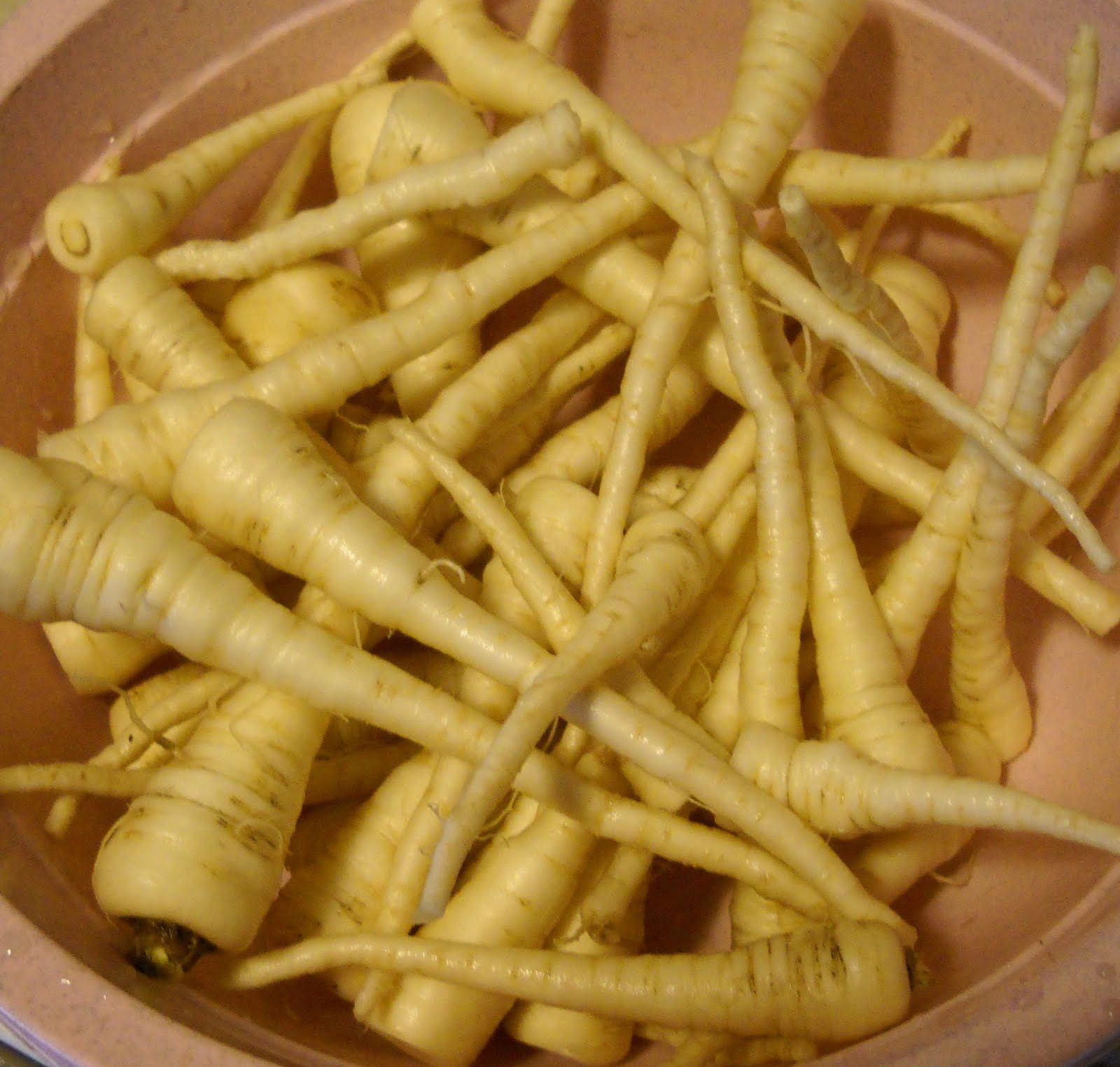
They are not from outer space, or from the Marianas trench. Nor are they 3D renderings of vital organs depicted in The Far Side.  To the best of my knowledge, they are parsnips, though somewhat different from the parsnips depicted on the seed package.  I had forgotten these specimens, unearthed last October, until yesterday.  It was past time to dig up any parsnips remaining in the ground, since many had sprouted a couple of inches of new green top.  Most of them were of the more conventional parsnip configuration, but there was one more with this strange configuration of multiple roots growing out of one top.  With so much surface area, these creatures are able to keep a solid grip on the ground they live in and I was lucky to have the benefit of soft spring earth on my side yesterday.  It took a little extra digging and a careful two-handed yank before I was able to view the freakish vegetable.  All of these oddities came from the same bed, where they had come of age alongside peas last summer.  Interesting.  While the difficulties of digging and cleaning multi-pronged roots are definitely drawbacks, the food is just as good and they look pretty cool.  Makes me wish there was a pageant they could be entered in. Yesterday's parsnip harvest was the second of this spring and yielded 3.8 edible kg.

surreal sunchokes


Sunchoke tubers sometimes resemble flower bulbs, sometimes a hybrid of the Pillsbury Doughboy and Pig Pen, often a sketch of multiplying yeast cells with random bloops all over the surface.  They readily detach themselves from the plants which bore them and are fairly agreeable about being removed from the soil.  No Easter egg hunt for me, thanks; I'd rather just grope about in the dirt here for tubers.  That's the fun part.  Figuring out what to do with them in the kitchen is the tough bit.  I think they could be excellent deep fried, like potato chips.  But we don't do that.                                                                                                                                                                    


Not far into the sunchoke bed, they started coming up with a generous coating of white fungus.  I haven't been able to find out what it is or whether is is safe to eat the tuber after peeling.  Ce n'est pa grave, though.  We have over 3 kg of good-looking sunchokes, and, given the culinary mystery of them, that amount should last us a while.


(This was two weeks ago.)

Friday, 8 February 2013

Terra firma - literally

The highs have been several degrees above 0C all week and the sun has shone on the parsnip bed.  It stood to reason, I thought, that the ground would yield sufficiently to allow me to remove a parsnip or two, even if they had to be pried out of the side of the mounded bed.  No go.  Not with an ordinary garden fork and my ordinary body weight, anyway.  Try again in March.

Thursday, 28 June 2012

Parsnips everywhere

the parsnip that started it all
It started in 2008, when I sowed my first parsnip seeds.  I wasn't that excited about it, associating parsnips with turnips, which I don't care to eat.  We dug up most of them the following spring but I left one in the ground to see what would happen.  In spite of my lack of experience, I knew it was a biennial plant and that something would happen.  Very much to my surprise, it grew to be almost as tall as me and branched out with great umbels that grew seeds.  I was in awe of it, much as I had been of bolted lettuce plants the first time I saw them.  It was some time after the seeds had developed sufficiently to produce new plants that the flower blew over in a storm, falling directly south toward the the fence.  No doubt there was a great scattering of seeds that night, but there was also the dragging of the plant off to the compost after we realized the stalk could not be righted.  Still, we had no idea how far those seeds had been flung.

In the spring of 2010, parsnips sprouted from the lawn.  They still do.  They emerged around the two bee balm plants where the flower toppled and along the periphery of that side of the garden.  I let them grow, thinking of them as potential food.  One of the volunteers growing right next to the cinder block border of the garden was our prize parsnip that year.  It was a huge effort to uproot it from where it had burrowed under the brick.  Others weren't worth picking; the next year they became flowers.  We let a few of them go, if they weren't in the way.  We had to remove one that grew to overhang a narrow pathway.   This was due to the ant hazard.  Ants find parsnip flowers to be great range land for their aphid herds.  You don't want to have to brush past a plant where defensive ants loiter at neck height.

What happened with the 2011 flowers, I don't know.  I thought we carefully removed all the seeds before they had a chance to escape.  Still, seeds got around.  The wind may have blown them off when we weren't looking.   2009 seeds from the distributed compost could have germinated.  I wouldn't put it past the ants; they love to carry stuff around just to show off their impressive jaw strength to body weight ratio.  There are now parsnips growing in every bed of the main garden.  I don't think they have infiltrated the new raised beds.

parsnip in bee balm

This is the smallest bee balm plant with a tiny parsnip.  It's difficult when they get in among the roots of perennials.  We pull parsnip leaves from the larger bee balm plants every week.  One even managed to make a flower before we caught it.  The root has to be exhausted eventually, I hope.


parsnips with lettuce
This is one of the beds where I sowed parsnips in 2011.  They did not do well.  I can't tell yet whether these are first or second year plants.  Though it's logical that last year's planting would yield second year plants here, I don't see any sign of a flower yet.  I think it would be happening by now.


parsnips with brussels sprouts

  Now here is a nightmare for some children: two of their not so favourite vegetables side by side.  I feel quite confident that these are growing from seeds this year.  I had snow peas and carrots in this section last year and was weeding like a fiend to keep sow thistle from going to seed here (for all the good that did).  Would have noticed parsnips.  I haven't checked The Vegetable Gardener's Bible to see if these two are good companions.  They are both doing fine.


parsnip with sunchokes
The sun chokes are growing so thick in this bed, it may be difficult to see the parsnip that is happily situated on the sunny side of the rectangle.  It's huge.  For a while I was thinking that anything that got that big that quickly had to be second year.  But I don't remember when this one started.  Another wait and see.  It will be interesting to see how deep it can grow.  The bed was created on top of lawn, so the root only has about eight inches to go before it hits the lovely hard packed clay substrate that we enjoy so much in Lethbridge.

They are found among the peas and pole beans and tomatoes, and growing out of the sides of the mounded beds. They are not fussy about where they grow or how deeply the seeds are planted.   All they need is water, light and space. With all the pests we find in the garden, nothing goes for parsnip leaves or roots. I have come to enjoy eating the roots, especially if prepared with butter and garlic. Somewhere I read that the leaves were edible, but then Barry (after I encouraged him to try eating a leaf) found several sources that say they are poisonous and can cause burns on contact with skin. I always wear gloves in the garden anyway.

parsnips with intent, and onions
I did sow a bed with parsnip seeds in May, from 2009 seeds.  Intended to do more when I figured out where they could go, but never did get it done.  This will not be enough.  Though there is space available, there is not enough growing season left.  Therefore I am leaving all the volunteers in place until they sprout stalks and umbels.  They may even do better than the mass planting, which is due for a thinning.  So why not just shake a couple of flowers over the entire garden in late summer and let them grow where they like?  Mainly because I want to know exactly where to dig for them in the winter, and because once I find a parsnip growing in the spring, it's hard to sacrifice it to make room for a beet, and because they might take over the planet.

Monday, 15 August 2011

Seedy surprise

A week ago Saturday I mentioned that a few blades of grass had been spotted in the front yard sheet mulching.  They were removed, but more followed, many more.  The same happened in the sheet mulch designated for strawberries in the back yard.  Hmmm.   The grass was appearing only in the newer areas.  The difference between the newer and older sections in the front was obvious because the first had been covered with the straw Angela gave me and the later portion had been covered with Granum straw the - colours were a little different.  The first compost I put down must have been finished, the second had viable weed seeds.  I felt a bit of a fool.

That foolish feeling went away in a hurry after I carefully pulled up a couple of blades to examine the roots (Please don't be quackgrass!) and discovered a brown shell at the bases of the stems.  Pulled up a few more, same thing.  That's when I remembered pulling apart another Granum bale a few days earlier and finding intact wheat heads (and recoiling in horror).
This changes everything.  Instead of being a poor sheet mulcher, I am suddenly a wheat farmer, looking forward to amber waves of grain on our windswept front yard.  So it wasn't long before I was rooting through that rejected bale to find those troublesome golden wheat berries.  They were distributed  around the bush beans, which are coming along nicely, and we'll see what happens.  This is awesome.

Besides the beans and volunteer wheat, radishes and garden cress planted in the sheet mulch are showing promise.  The herbs are slow, as expected, and the lettuce mysteriously disappeared overnight.  Slug?

Self-seeding is vastly more pleasant when done by some plants than others, for instance, sunflowers instead of hairy goat's beard.  We have a few sunflowers in the front garden.  Don't remember how they got there.  Maybe I planted them before realizing that sunflowers, at least the ones on our property, always face east.  We get a nice view from the house, but it's a bit rude to people passing on the sidewalk.  The soil is poor and the stalks are thin and stunted, yet they manage to produce seeds and provide a generation for the next summer.  The same happens back in the alley, where they were once planted for privacy and maybe to  show a friendly face to people in the alley - a respectable number of pet walkers and other pedestrians, as well as motorists.  These flowers self-seeded also, but into a much more nurturing environment than their relatives on the street side of the house.  Several have reached 7 feet and the tallest was measured at 9.5 feet on Friday.  Good bean poles for next summer.  Delightful for the time being.

Our other crop of volunteers is the lawn parsnips.  In 2009 we allowed a 2008 parsnip to grow into a huge flower.  It was over 5 feet tall when it blew over in a storm, sending it's seeds far and wide.  The lawn is full of them.  Not much good for eating mind you, since the ground is hard, dry clay, but they could probably produce seeds for us in a pinch.  Some of the errant seeds landed in the garden, though.  One escaped weeding and grew unfettered at the very edge, reaching down beside and then underneath the cinder block border.  It was a huge amount of work to uproot and our biggest catch of that year.

Sometimes I think the good seed surprises make up for the weeds.  Nature can be fair and balanced.

Wednesday, 13 April 2011

Spring cleaning

It's amazing what one can get used to.  I put together a small photo album for the permaculture consultants who are going to transform our property into a more productive and less laborious landscape.  Could the sight of flat, brown garden beds under a grey sky inspire a grand design?  Does it help to have a couple dozen water-filled plastic bottles, previously used for weights, strewn about at random, serving no purpose?  How about endless aluminum cans (cutworm barriers) that didn't make it back into the storage area after the last harvest?  Solar garden lamps are askew, shreds of green plastic compost bags litter the soil, and the lawn has never looked worse.  Therefore, I also allowed them to view my garden album from last summer, which was nearly a shock to me when I reviewed the photos recently (see the strip under the blog title for a sample).  I had almost forgotten that nature had colours other than brown and was inspired by the thought that this dazzling green could be here two months from now.  But it's good to have ugly "before" pictures, right?


Not much has been done about the non-organic stuff, but this past weekend I walked around with a big bucket, quietly calling "Bring out your dead!".  Mainly in reference in dead leaves and grass, of course.

The lawn (it was hard to even call it that) was pale, dry grass squashed flat and matted together and didn't appear to bear any potential for renewed life.  Luckily, we have a dethatcher, a vicious kind of rake that gives a good comb and tease to the grass.  I usually dethatch a bit later in the season and am rewarded with a greener, fluffier patch of grass than I started with.  This time of year there isn't much green, so the lawn just gets a little fluffier, and dirtier.  The rake really is vicious, the ground is wet with melted snow, and the grass roots, not so robust at this time of year, are easily yanked.  There are bald spots here and there and I know I should have been more patient, but now the new grass has better access to sunlight and that chore is done (and my back has almost recovered).

The front garden accumulates leaves in the fall and we allow them to stay to give what comfort they can to the many perennials that are stuck in that harsh environment.  Now that the daily high was into double digits, I felt okay about exposing them to the fresh air.  Let them grow while they can.  We still have an ample supply of bagged leaves that can be emptied to provide temporary shelter again in the event that severe cold returns in the next few weeks (which is almost guaranteed).


The best part of cleaning up from winter was unearthing last year's parsnips, including two that might have been huddled together for warmth, or maybe one is trying to consume the other.  Can't blame it; they are delicious.  We've had a few meals of these, humbly prepared in the microwave oven with butter and home grown garlic (also last year's, dried).


Getting the outdoors spiffed up for a new season is a bit of work.  That's my excuse for neglecting the more traditional version of spring cleaning, interior.